

Key Takeaways
- Behavior is a Physiological Response: Defiance and intense meltdowns are rarely conscious power plays; they are frequently driven by sympathetic dominance (a nervous system locked in fight-or-flight mode).
- The Vagus Nerve Controls the Brake Pedal: Healthy emotional regulation and impulse control rely on strong vagal tone to activate the parasympathetic nervous system, allowing children to calm down after emotional triggers.
- Subluxation Disrupts Brain-Body Communication: Spinal misalignments can distort proprioception and overstimulate stress pathways, making behavioral therapies difficult to absorb until nervous system interference is cleared.
You ask your sweet kiddo to put on their shoes. Thirty seconds later, you’re caught in an all-out standoff over a pair of sneakers.
You stayed calm. You stayed consistent. You tried counting to three, taking deep breaths, and offering choices. And somewhere along the way, well-meaning advice told you that if you were just a little more consistent, these big behavioral storms would stop.
If you’re reading this with a tired heart, please hear us: you are not failing your child. You are an incredible parent doing everything in your power for a child who fights you on the simplest routines. You’ve likely tried every sticker chart, consequence, and parenting book out there, and you’re simply exhausted from collecting clinical labels without ever getting real answers.
What Does an ODD Diagnosis Actually Tell Us?
An Oppositional Defiant Disorder (ODD) diagnosis describes a persistent pattern of outward behaviors—such as frequent anger, arguing, and defiance—but it does not identify the underlying neurological or physiological root causes driving that stress response.
An ODD diagnosis gives a medical name to the behaviors you live with every single day. While that can validate that you aren’t imagining things, it often leaves you right back where you started: Why does a simple “no” trigger a four-alarm fire in my child’s body? Why can other kids bounce back, while mine spirals for an hour?
A diagnosis simply describes what a struggle looks like on the outside. It doesn’t tell us what is happening on the inside.
Clinically, ODD is defined by an ongoing pattern of irritable mood, argumentative behavior, and vindictiveness lasting at least six months across multiple settings (mild in one setting, moderate in two, severe in three or more). But here’s the thing: many kids only fall apart at home. Why? Because home is where your child finally feels safe enough to let go of the immense tension they’ve been holding together all day long.
Criteria can group behaviors, but they were never designed to explain why your child’s internal alarms are sounding.
Why Don’t Kids Just “Grow Out” of Defiant Behavior?
Children rarely outgrow persistent defiance on their own because behavioral challenges are often physical symptoms of an overwhelmed, dysregulated nervous system that has lost its ability to self-soothe.
According to the DSM-5-TR, ODD affects roughly 3.3% of children, and it frequently overlaps with other neurodevelopmental patterns—showing up in over 50% of kids diagnosed with ADHD and over 60% of kids on the Autism spectrum.
Research from the American Academy of Child and Adolescent Psychiatry reveals that while about 67% of kids no longer meet the clinical criteria for ODD after three years, nearly 30% progress toward more severe behavioral struggles. Many others simply shift gears, showing up down the road with anxiety, chronic sleep troubles, sensory overload, or mood challenges.
When you look at those numbers, a clear picture emerges: the behavior doesn’t just vanish; it changes costumes. A nervous system that never learned how to find its internal brake pedal doesn’t suddenly balance itself out at age twelve. It just finds new ways to express that chronic stress.
Is Defiance Really a “Gas Pedal” Problem in the Nervous System?
Yes; extreme defiance is often the direct result of sympathetic dominance, where the “fight-or-flight” branch of the Autonomic Nervous System remains stuck on high alert, perceiving everyday requests as direct threats.
Think of your child’s body like a family car with a gas pedal and a brake pedal:
- The Sympathetic Nervous System is the gas pedal: It’s fight-or-flight, high alert, ready to protect.
- The Parasympathetic Nervous System is the brake pedal: It’s rest, digestion, emotional calm, and recovery.
A well-regulated child moves smoothly between the gas and the brake. When it’s time to hustle to soccer practice, the gas engages; when it’s time to wind down for bed, the brake steps in.
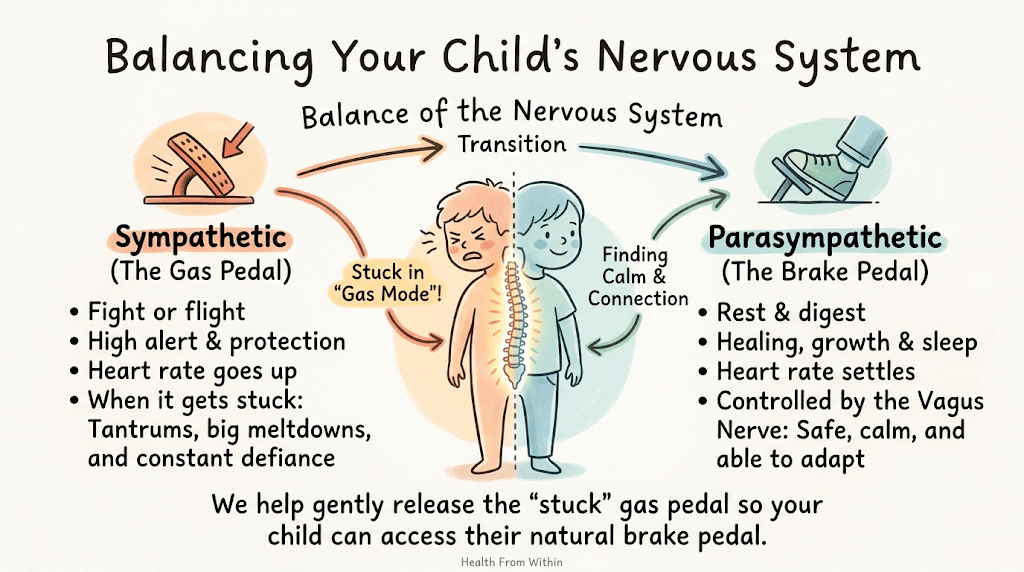
When a child’s gas pedal is pinned to the floor, everyday transitions like putting shoes on or powering down a screen don’t register as minor steps—they register as an emergency. Your child isn’t consciously picking a fight; their internal alarm went off first, and the meltdown is the body’s involuntary emergency response.
In the clinical world, this state of chronic autonomic imbalance is known as dysautonomia. That explosive behavior isn’t a power struggle—it’s a stressed-out nervous system asking for help.
How Does the Vagus Nerve Regulate Emotional Calming?
The Vagus Nerve serves as the primary highway of the parasympathetic system, sending calming signals directly from the brainstem to the heart, gut, and lungs to down-shift the body out of survival mode.
The vagus nerve wanders down from the brainstem through the neck, chest, and abdomen, coordinating heart rate, digestive motility, immune response, and emotional regulation. When vagus nerve tone is high, a child has greater neuro-flexibility and can easily bounce back after big feelings.
We measure this resilience using Heart Rate Variability (HRV). Research examining kids with behavioral diagnoses shows distinct autonomic profiles—many display heightened baseline arousal paired with an inability to engage their vagal brake under mild stress.
Families in Orland Park and the surrounding Chicago suburbs often visit Health From Within Orland Park specifically for this neuro-focused approach, because two kids with the exact same behavioral label can have entirely different nervous system patterns. Instead of guessing, we measure.
What Causes the “Perfect Storm” of Nervous System Stress?
Nervous system dysregulation typically develops gradually through a cumulative series of early stressors, including maternal stress, physical birth interventions, and early digestive disruptions.
At Health From Within Orland Park, we frequently trace sensory and behavioral struggles back through a timeline we call the Perfect Storm:
- Prenatal Stress: High maternal stress or anxiety signals to the developing baby’s system to prepare for a hostile, stressful world.
- Birth Interventions: Interventions like forceps, vacuum extraction, or C-sections can place significant mechanical traction on an infant’s delicate neck and upper cervical spine—the exact anatomical zone where the vagus nerve exits the skull.
- Early Gut & Immune Challenges: Frequent early antibiotics or tummy issues can disrupt the microbiome, which communicates directly with brain function via the gut-brain axis.
- Sensory Overload: Living in constant sensory stimulation keeps stress-response pathways firing non-stop.
If you recognize your child’s early years in this list, please take a deep breath and let go of any guilt. You didn’t cause this. Understanding this timeline simply helps us locate where the stress first got locked into their physiology.
Why Do Behavioral Strategies Stall When a Child Is Stuck in Survival Mode?
Behavioral interventions, reward charts, and mindset coaching stall because a brain stuck in protective fight-or-flight cannot access higher-level executive functioning until physical neurological tension is removed.
A primary contributor to a locked-on stress response is subluxation—a neuro-spinal shift that creates joint restriction and neurological interference. When spinal joints become restricted, the brain loses crucial proprioception (the body’s internal sense of movement and spatial safety). Without clear proprioceptive feedback, the brain perceives itself to be under physical threat.
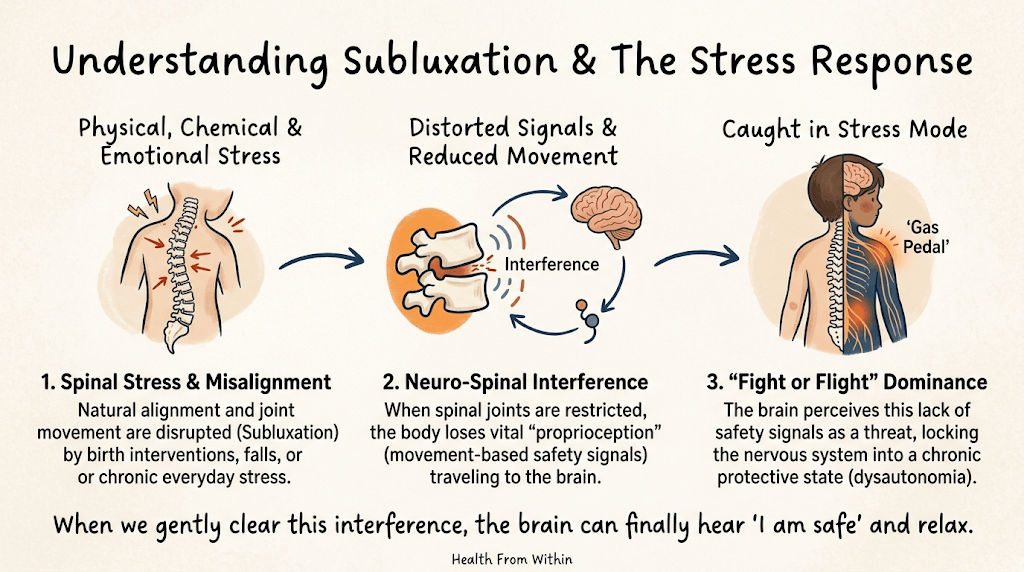
Trying to teach emotional regulation skills to a child locked in physical sympathetic overload is like trying to push a car with the emergency brake engaged.
Once we restore balance to the spine and calm the central nervous system, parents frequently find that occupational therapy, speech exercises, and gentle parenting boundaries finally start clicking. The strategies didn’t fail—your child’s system simply needed the neurological capacity to receive them.
How Does Pediatric Chiropractic Measure Nervous System Function?
Neuro-functional pediatric chiropractors use non-invasive diagnostic scans to assess stress along the spine and objectively track autonomic nervous system balance.
At Health From Within Orland Park, we eliminate the guesswork using INSiGHT™ scanning technology, which includes three safe, gentle evaluations:
- neuroTHERMAL Scans: Evaluate autonomic temperature balance along the spinal cord to pinpoint areas of dysautonomia.
- neuroCORE Surface EMG: Measures muscle tone, energy expenditure, and postural tension patterns along the spine.
- Heart Rate Variability (HRV): Maps overall autonomic balance, indicating whether your child is stuck in the “gas pedal” or able to tap into their “vagal brake.”
These scans do not diagnose medical conditions; instead, they map out exactly where neuro-spinal stress is stored so we can create a clear, personalized plan to help your child adapt, settle, and thrive.
Take the Next Step Toward Answers
Your child doesn’t need another label—they need answers, gentle support, and a nervous system that feels safe.
If you are navigating behavioral, sensory, or emotional hurdles, our friendly team is here to walk alongside you. Reach out to Health From Within Orland Park today to schedule an initial consultation and gentle INSiGHT scans.
(Not located in the Chicagoland area? Explore the PX Docs network to find an authorized pediatric neuro-chiropractic clinic near you.)