
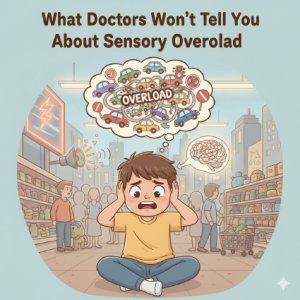
 Does this sound familiar? Your child suddenly covers their ears in a noisy restaurant. A quick trip to the grocery store turns into an unexpected meltdown. Or maybe the “wrong” pair of socks or a scratchy clothing tag ruins the entire morning.
As a parent, these moments are exhausting and, honestly, a little isolating. You’ve probably been told it’s just a “phase” or a “behavioral issue.” But your gut is telling you something else.
What if we told you those meltdowns aren’t a choice? It’s not a tantrum; it’s a traffic jam in your child’s nervous system.
More Than Just “Bad Behavior”
When your child gets overwhelmed, their brain is receiving way more sensory data than it can organize. Imagine trying to listen to five different people talking to you at once while a siren goes off in the background. You’d want to cover your ears, too!
The “Stuck” Gas Pedal
Your child’s nervous system has two main settings:
- 1. Fight or Flight (The Gas Pedal): This is for emergencies and protection.
- 2. Rest and Digest (The Brake Pedal): This is for calm, sleep, and processing information.
When a child has sensory processing challenges, they often get stuck in Sympathetic Dominance. Essentially, their “Gas Pedal” is floored 24/7. When they are stuck in this high-alert mode, everything feels like a threat—loud noises, bright lights, even the texture of their dinner.
This is why you might also see:
- Trouble falling or staying asleep
- Tummy issues or picky eating
- Big emotions that seem to come out of nowhere
- Extreme sensitivity to touch or sound
How the “Traffic Jam” Started
We often look at what we call the “Perfect Storm.” Sensory challenges don’t usually happen in a vacuum. They can start with:
- Prenatal Stress: High cortisol levels during pregnancy.
- Birth Stress: Interventions like C-sections or vacuum extractions can put physical pressure on the upper neck, right where the “calm down” nerve (the Vagus nerve) lives.
- Early Milestones: If the nervous system starts off stressed, it struggles to adapt as the world gets bigger and louder.
Seeing the Signs
Overstimulation looks different for every kid. Keep an eye out for:
- Physical: Headaches, nausea, or looking “wiped out” after school.
- Emotional: Quick to anger, rising anxiety, or “exploding” the second they get home to their safe space.
- Behavioral: Zoning out, frequent meltdowns, or constantly looking for a dark, quiet place to hide.
A Different Way to Help
Most traditional advice tells you to avoid “triggers”—stay away from the store, cut out the tags, wear the noise-canceling headphones. While those help in the moment, they don’t fix the underlying “traffic jam.”
At Health From Within Orland Park in Orland Park, IL, we look at the root cause. We use something called INSiGHT Scans. They are totally non-invasive (no needles, no pain) and can be done while your child sits in your lap. These scans show us exactly where the nervous system is “stuck” in stress mode.
Moving Forward with Hope
Your child isn’t choosing to be difficult. Their nervous system is just struggling to keep up with the world. But here’s the good news: the nervous system is incredibly plastic—it can change, adapt, and learn to regulate.
Ready to find some calm in the chaos?
We’re here to help you navigate this! Reach out to Health From Within Orland Park today to schedule a consultation. Not in our area? No problem—check out the PX Docs directory to find a neurologically-focused chiropractor near you.
Your child’s sensitivity isn’t a flaw; it’s just a sign they need a little extra support to find their balance.
CONTACT US