

Key Takeaways
- Co-Regulation Is Biological: Children build self-regulation by mirroring their parents’ autonomic state; a parent’s calm nervous system provides the physiological blueprint for a child’s emotional recovery.
- Vagal Tone Restores the Brake Pedal: Healthy parasympathetic tone driven by the vagus nerve allows both parent and child to transition smoothly out of fight-or-flight into rest, digestion, and healing.
- Clearing Subluxation Breaks the Stress Loop: Neuro-spinal subluxation distorts proprioception and fuels dysautonomia, keeping parents trapped in a “wired but tired” state that can stall family-wide healing.
You initially brought your child in because your family was in survival mode. The explosive meltdowns over small transitions, bedtime battles lasting hours, chronic constipation, and sensory overload turning an ordinary Tuesday afternoon into a four-alarm crisis.
You gave it everything you had: the pediatrician’s checklists, sensory diets, therapy appointments, and diet overhauls. When you began neurologically-focused chiropractic care, the needle finally moved. INSiGHT scans showed real change, bedtime became peaceful, mornings felt lighter, and you could finally catch your breath.
Then came the gentle question during your child’s visit:
“Mom, when are we going to scan you, too?”
That question isn’t an upsell or an afterthought. Your child’s nervous system doesn’t learn how to calm down in a vacuum—it mirrors yours.
If you have spent months or years white-knuckling your way through appointments, researching until midnight, and putting yourself dead last on every priority list, hear this: you are not failing, and you are not the problem. You are the missing piece of the healing puzzle.
Why Does a Child’s Behavioral Progress Sometimes Stall?
A child’s developmental and behavioral progress can plateau when a parent’s nervous system remains locked in chronic fight-or-flight, because children rely on their caregivers’ physiological baseline to sustain long-term regulation.
It is a common scenario in our practice: a child is making strides, their adjustments are holding, and then progress suddenly plateaus. The home environment still feels like walking on eggshells, and mom or dad is running entirely on fumes.
When we scan the parent, the results often look remarkably like their child’s initial intake: stuck in heavy sympathetic dominance, showing patterns of dysautonomia (autonomic dysregulation) with almost no energy reserves left on the restorative side.
This is basic neurobiology. Clinical research demonstrates that when parents and children interact, their autonomic nervous systems physically synchronize—their heart rate variability and breathing align. If one nervous system is locked in high-alert survival mode, the other picks up that silent alarm. Taking care of your own nervous system isn’t self-indulgence; it is the most direct way to reinforce your child’s progress.
Families in Orland Park and the surrounding Chicago suburbs often visit Health From Within specifically for this neuro-focused approach to support the health of the entire household under one roof.
What Is Co-Regulation, and Why Isn’t It Just a Parenting Technique?
Co-regulation is the biological process where an infant or child’s immature nervous system stabilizes its heart rate, respiration, and stress hormones by synchronizing with a regulated caregiver’s autonomic system.
Co-regulation is not a script, a tone of voice, or a forced breathing exercise. It is an involuntary physiological state transmitted through your posture, eye contact, and autonomic tone:
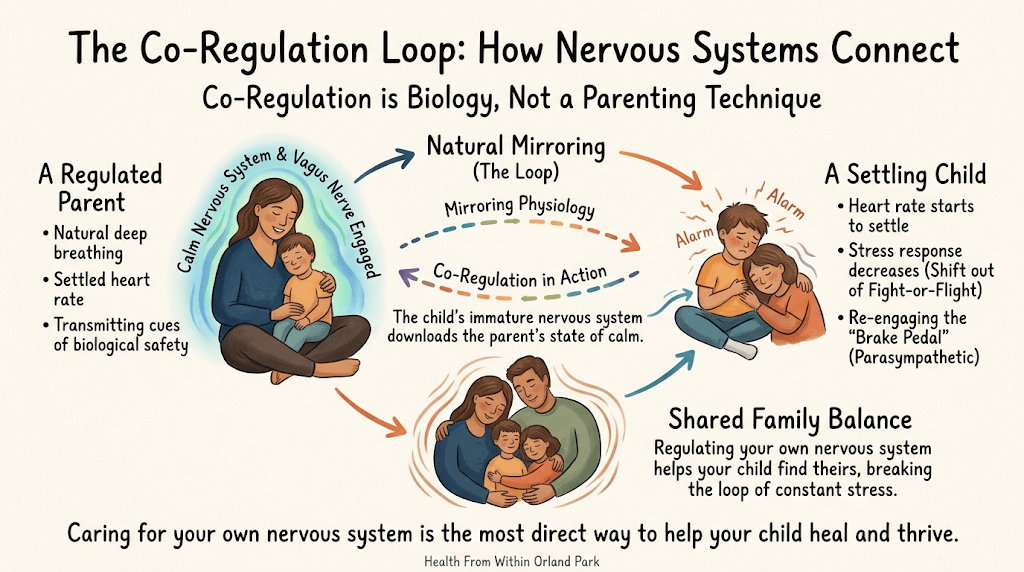
Developing brains rely heavily on their parents’ nervous systems to learn how to hit the internal brakes. Your child is constantly downloading your internal physiological state. If your own nervous system is caught in a storm, your body cannot project the calm signals their system needs to settle.
How Do the Gas Pedal, Brake Pedal, and Vagus Nerve Work?
The Autonomic Nervous System balances a sympathetic “gas pedal” that activates stress responses with a parasympathetic “brake pedal”—governed by the vagus nerve—that allows the body to slow down, rest, and digest.
- Sympathetic Branch (Gas Pedal): Triggers alertness, high heart rate, muscle tension, and vigilance to navigate perceived threats.
- Parasympathetic Branch (Brake Pedal): Mediates digestion, cell repair, tissue recovery, and emotional resilience.
The main communications highway of your brake pedal is the vagus nerve, extending from the brainstem down into the heart, lungs, and gut. When your vagus nerve carries high tone, you can encounter a toddler’s meltdown, process the sensory stress, remain grounded, and help pull your child out of their storm.
However, when neuro-spinal subluxation—misalignment and restricted motion that causes physical interference within the spinal cord—is present, that vagal brake cannot properly engage. The gas pedal stays pinned to the floor. When your patience evaporates and your shoulders tense instantly during a meltdown, it is not a lack of love or willpower; your physiological brakes are mechanically locked out of reach.
Why Do Moms Get Stuck in “Wired but Tired” Survival Mode?
Mothers frequently get stuck in chronic sympathetic dominance due to the physical toll of pregnancy and birth, long-term sleep deprivation, and sustained emotional vigilance over their family’s needs.
Physical, chemical, and emotional stressors build up over decades. Pregnancy, labor physical strain, broken sleep, and the nonstop mental load of caring for a struggling child accumulate directly within the neuro-spinal architecture.
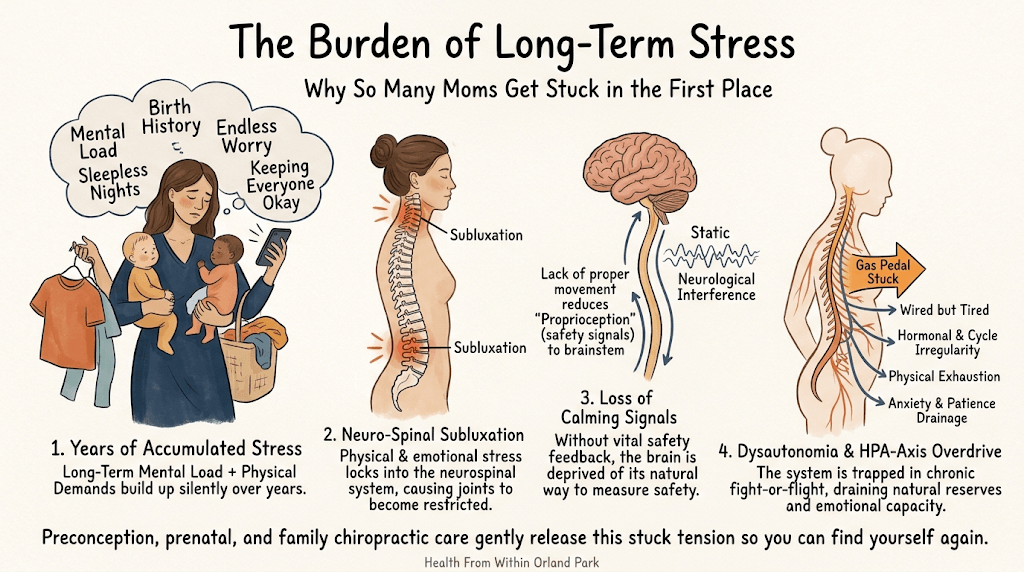
This ongoing tension distorts proprioception—the sensory feedback movement provides to tell the brain it is physically safe. Without clear proprioception, the brain defaults to emergency mode, overactivating the Hypothalamic-Pituitary-Adrenal (HPA) axis and flooding the body with cortisol.
The resulting “wired but tired” state—where you are physically exhausted during the day yet unable to settle into restorative sleep at night—is a clear clinical indicator of sympathetic dominance.
What Changes When Parents Receive Neurologically-Focused Care?
When parents receive neuro-toning adjustments, their autonomic tone balances, leading to deeper restorative sleep, steady day-to-day energy, regulated hormonal cycles, and increased emotional patience.
Because your central nervous system coordinates every tissue in your body, restoring proper neuro-spinal motion creates wide-ranging improvements:
- Sustained Physical Energy: Relieving chronic neurological tension frees up vital energy reserves previously wasted on posture and fight-or-flight readiness.
- Deep Sleep Cycles: An active parasympathetic system allows brainwaves to shift into non-REM restorative sleep, so eight hours in bed actually feels refreshing.
- Emotional Grounding: Moving out of survival mode re-engages the prefrontal cortex, expanding your window of tolerance during stressful parenting moments.
- Hormonal Regularity: Calming the stress-driven HPA axis allows the HPG axis to normalize reproductive cycles and mood swings.
- Postpartum Resilience: Clinical evidence ties postpartum emotional strain directly to sustained autonomic imbalance; balancing the nervous system provides foundational physical support during recovery.
How Does Caring for the Parent Multiply Health for the Whole Family?
Regulating a parent’s nervous system creates a positive ripple effect, because a calm, grounded parent naturally facilitates faster emotional settling and recovery for their children.
The dynamic is straightforward:
- Dysregulated Parent: Heightened stress response → Amplified child tantrums → Escalating household stress.
- Regulated Parent: Grounded nervous system → Successful co-regulation → Calmer, more resilient family dynamic.
When your nervous system functions smoothly, your child is gifted an anchored harbor during their emotional storms. Care plans that include both parents and children consistently achieve faster, more durable stability because everyone’s nervous systems begin working together instead of clashing.
How Do INSiGHT™ Scans Detect Autonomic Stress in Parents?
INSiGHT™ scanning technology objectively detects and measures areas of spinal tension, temperature imbalance, and autonomic exhaustion using painless, non-invasive sensors.
At Health From Within Orland Park, we take the guesswork out of your health. An INSiGHT™ evaluation takes less than 20 minutes and uses three reliable assessments:
- neuroTHERMAL Scans: Evaluates autonomic temperature differences along the spine to locate specific areas of dysautonomia and organ stress.
- neuroCORE Surface EMG: Measures muscle tension and spinal motor strain, revealing how much physical energy your body burns just staying upright.
- Heart Rate Variability (HRV): Maps your autonomic balance, clearly showing whether you are running on empty or operating with healthy vagal reserves.
These scans do not diagnose medical conditions; they locate the underlying neuro-spinal tension and subluxation that lock your body into chronic exhaustion.
Take the Next Step Toward Family-Wide Wellness
You don’t have to keep running on fumes, and you don’t have to wait until “things settle down” to care for your own health. Your family needs you regulated, healthy, and supported.
Ready to take your foot off the gas and find lasting balance? Reach out to Health From Within Orland Park today to schedule your family’s consultation and gentle INSiGHT™ scans.
(Located outside the Chicagoland area? Explore the PX Docs directory to locate an authorized pediatric and family neuro-chiropractic clinic near you.)