

Key Takeaways
- Speech is a Motor-Planning Circuit: Childhood Apraxia of Speech (CAS) is not a muscular weakness; it is a neurological transmission breakdown where motor sequencing signals from the brain fail to reach speech structures accurately.
- Upper Cervical Interference Blocks the Signal: Physical birth strain or injury creates subluxation in the upper neck, distorting proprioception and suppressing parasympathetic tone needed for fine motor coordination.
- The Foundation Unlocks Therapy: Restoring autonomic balance and calming dysautonomia clears neuro-spinal static, giving speech-language therapy the steady neurological foundation it needs to stick.
You’ve made it to every speech evaluation on the calendar. You’ve spent countless hours sitting outside the therapy room, practicing sound repetitions at the kitchen table, flipping through flashcards, and trying every tactile cue your speech therapist suggested.
Yet, your child is still fighting an uphill battle to get their words out.
Not because they don’t know what they want to say, and certainly not because they aren’t trying. Your little one is likely putting in more effort every single day than most adults do in a week.
Then came the label: Childhood Apraxia of Speech (CAS). Along with it came advice that can stop any mom or dad in their tracks—that the cause is unknown, that your child will simply manage this long-term, and to start preparing for alternative communication devices.
If that moment knocked the wind out of you, please know our entire team is in your corner. We sit down with families in this exact spot every single week. There is a foundational piece of the puzzle that almost nobody mentions:
Once you understand where that signal is hitting static, a whole new door of hope opens for your family.
What Is Childhood Apraxia of Speech (CAS)?
Childhood Apraxia of Speech is a neurological motor-planning challenge where the brain understands language but struggles to sequence and send clean motor commands to the lips, tongue, jaw, and palate.
Here is something that should bring immediate comfort: your child’s brain knows precisely what it wants to communicate.
The facial muscles are not weak or paralyzed. The breakdown occurs in the neurological bridge that plans, coordinates, and executes rapid muscle movements in the correct order.
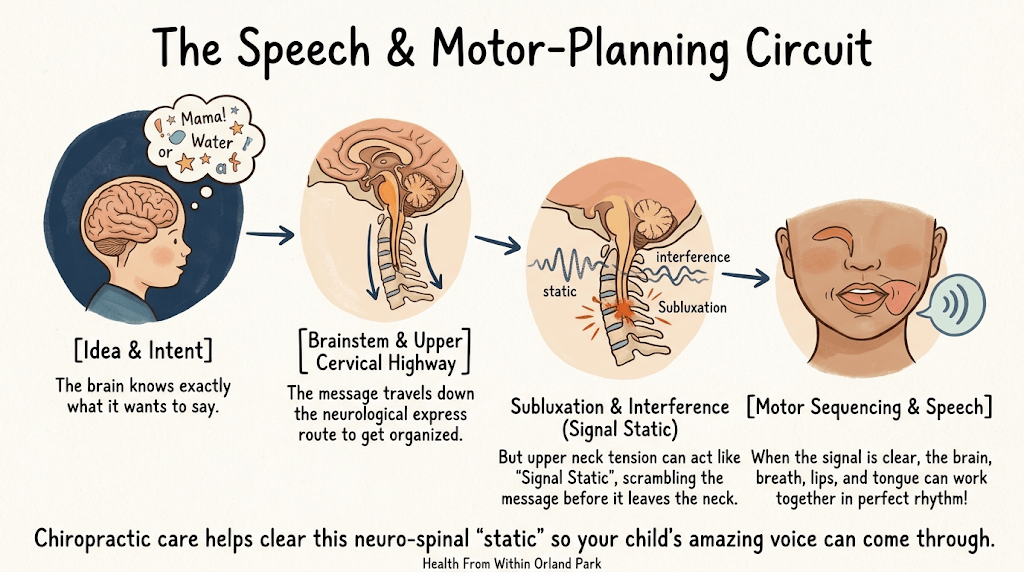
Think about what has to fire simultaneously for your child to simply say “Mama”: the brain must coordinate breath support, vocal cord tension, palate lift, jaw position, and lip movements with millisecond precision. When there is static on the line, the motor plan gets scrambled, resulting in choppy sounds, intense physical straining, or silent frustration.
It is not a lack of effort or intellect—it is interference along the neurological wiring.
Why Does Speech Delay Often Begin with Early Physical Stress?
Early speech challenges often stem from accumulated physical stress, particularly birth interventions that strain the delicate upper cervical spine and cranial nerves responsible for swallowing, soothing, and speech.
When a family visits our clinic with an apraxia diagnosis, we sit down and dig into their health history from day one. More often than not, the same clinical breadcrumbs appear:
- Long or stalled labors
- Breech or posterior positioning
- The use of forceps or vacuum extraction
- Emergency or scheduled C-sections
As infancy progressed, other subtle red flags were usually present:
- Colic, chronic fussiness, or intense acid reflux
- A shallow, painful, or clicking latch during feeding
- Persistent constipation and tummy discomfort
- Chronic ear infections and repetitive rounds of antibiotics
- Torticollis or an asymmetrical head-tilt preference
- Skipped or short crawling stages
Each symptom was likely treated by different providers as an isolated issue. But when viewed through the lens of nervous system development, they are all connected. Speech wasn’t the first sign of interference; it was simply the loudest symptom once higher-level milestones came due.
Families in Orland Park and the surrounding Chicago suburbs often visit Health From Within Orland Park specifically for this neuro-focused approach to connect the dots behind their child’s early health challenges.
What Is the “Perfect Storm” Behind Speech Delays?
The “Perfect Storm” is a sequential buildup of developmental stressors—prenatal stress, birth trauma, and early immune or gut distress—that shifts a child’s autonomic nervous system into permanent survival mode.
At Health From Within Orland Park, we view conditions like apraxia as a progression:
- Prenatal Strain: Maternal emotional or physiological stressors crossing placental pathways, priming the baby’s system for hyper-alertness.
- Birth Trauma: The physical traction placed on a newborn’s head and neck during delivery, causing localized structural strain at the brainstem.
- Early Toxic & Immune Load: Antibiotics, reflux medications, and gut irritation disrupting the gut-brain axis during crucial neurodevelopmental windows.
When these layers accumulate, a child’s autonomic system shifts out of equilibrium, locking them into a sympathetic “gas pedal” state that makes fine motor coordination difficult to achieve.
How Does Subluxation and the Vagus Nerve Disrupt Speech?
A subluxation in the upper cervical spine causes neurological interference and distorts proprioception, while simultaneously irritating the vagus nerve and cranial nerves that control speech coordination.
Subluxation involves three key steps:
- Misalignment: Subtle shifts in spinal vertebra alignment.
- Restricted Motion: Fixation and loss of joint mobility.
- Neurological Interference: A disruption in the stream of neurological data traveling between the brain and body.
That sensory input is called proprioception—the brain’s internal GPS that tells it where the body is in space. When upper cervical joints are fixated from birth trauma, proprioceptive signals become scrambled.
This mechanical stress occurs directly over the brainstem, which manages:
- Autonomic Regulation: Digestion, restful sleep, and immune health.
- Sensory Processing: Filtering out background noise and recognizing safety.
- Motor Control: Posture, tone, and speech motor-planning pathways.
Additionally, this area houses the pathway for the vagus nerve—the master regulator of the calming parasympathetic system. When upper neck tension leads to dysautonomia (a nervous system locked on high alert), speech motor plans struggle to execute cleanly.
Why Must Nervous System Regulation Come Before Therapy?
Therapies like speech and OT are brain-building inputs that require an adaptable, calm nervous system to integrate; if a child’s brain is locked in survival mode, higher-level motor planning cannot effectively take root.
Traditional speech therapy is invaluable—it teaches children the necessary motor pathways and articulation drills. But therapy asks the higher cortical areas of the brain to perform complex motor tasks while the neurological foundation beneath it may still be overwhelmed.
We view successful care like a baseball batting order:
- The Central Nervous System: Clear subluxation and calm the fight-or-flight response.
- The Sensorimotor System: Balance muscle tone, head control, and proprioceptive awareness.
- The Gut & Immune Axis: Restore smooth digestion, elimination, and immune defense.
- Therapeutic Integration: Speech, occupational, and physical therapies build upon a stable base.
When you restore the correct batting order, speech exercises gain traction much faster. Parents often tell us that their speech-language pathologist was the first person to notice that sounds suddenly started clicking.
How Do INSiGHT™ Scans Detect Speech-Related Interference?
Neuro-functional pediatric chiropractors use non-invasive INSiGHT™ scanning technology to detect and measure dysautonomia, nerve interference, and muscle strain around the brainstem and cervical spine.
At Health From Within Orland Park, we measure rather than guess. We evaluate your child using gentle diagnostic scans:
- neuroTHERMAL Scans: Detect autonomic stress and temperature imbalances along the upper cervical spine, highlighting areas of dysautonomia.
- neuroCORE Surface EMG: Measures tension patterns, neuromuscular symmetry, and neurological energy waste along the muscles that support head, neck, and jaw stability.
These non-invasive scans do not diagnose medical conditions. Neurologically-focused chiropractic care is not a medical treatment or “cure” for apraxia. Instead, these objective scans help us locate precisely where neuro-spinal tension and subluxation are disrupting brain-body communication so we can build a gentle, custom adjusting plan.
Help Your Child Find Their Voice
Your child is not stubborn, lazy, or broken. Their central nervous system has simply been working against physical static on the line, turning every single syllable into an uphill climb.
You know how bright, funny, and expressive your child is inside. You don’t have to navigate this journey alone, and you don’t have to settle for unanswered questions.
If you are ready to address the root cause of your child’s developmental roadblocks, reach out to Health From Within Orland Park today to schedule your child’s comprehensive evaluation and gentle INSiGHT™ scans.
(Located outside the Chicagoland region? Visit the PX Docs directory to locate an authorized pediatric neuro-chiropractic clinic near you.)